
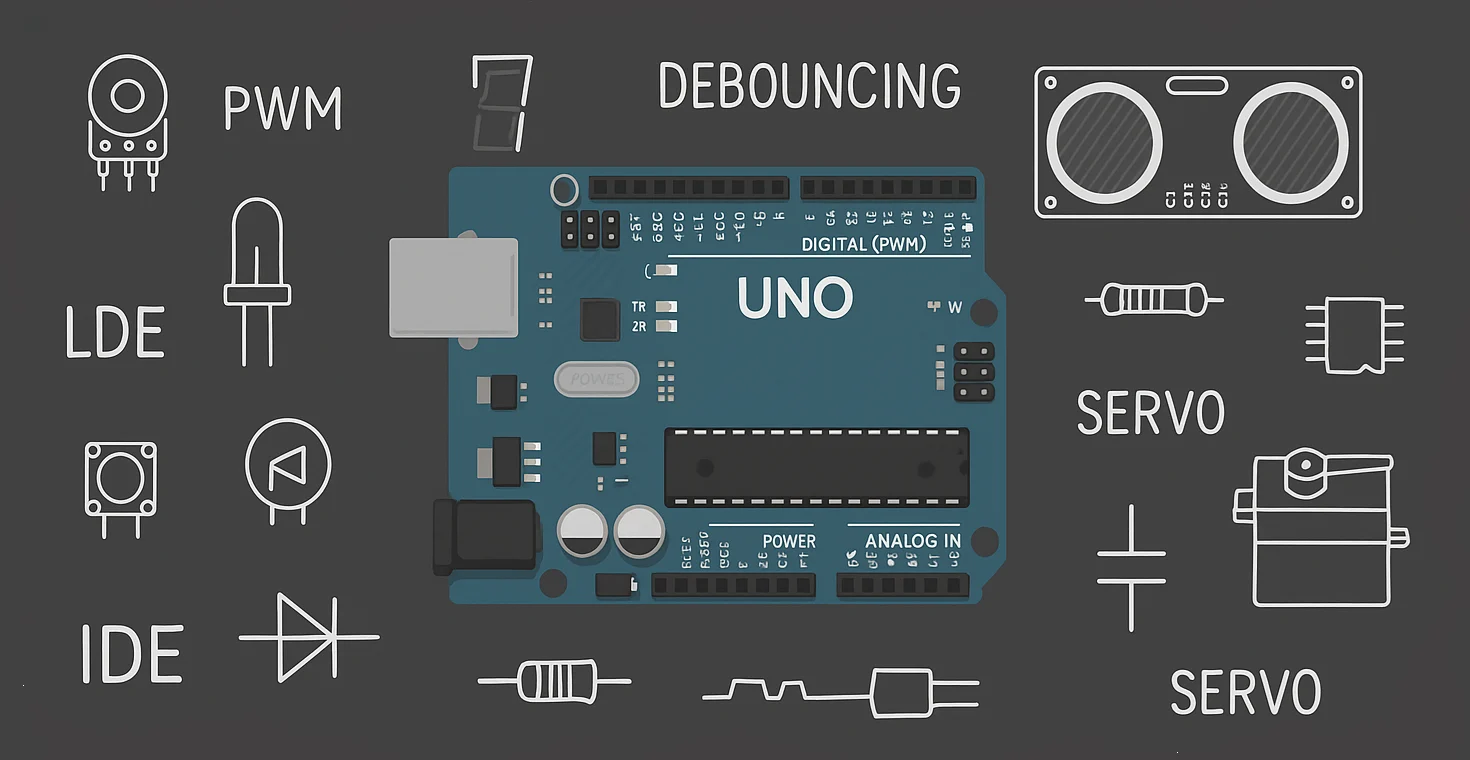
Chapter 1
Arduino is a beginner-friendly microcontroller platform that lets anyone build electronic projects without needing deep knowledge of embedded systems. It bridges the gap between electronics and programming by giving you a simple board, a simple language, and a huge amount of freedom.
But the real reason Arduino became famous is simple:
It lets you turn ideas into working circuits faster than anything else.
From blinking an LED to controlling a drone, Arduino gives you everything you need to prototype, test, learn, and debug.
✨ Why Arduino Exists
Before Arduino, working with microcontrollers meant:
Expensive programmers
Complex toolchains
Manually configured compilers
Sparse documentation
Very beginner-unfriendly workflows
Arduino changed this world completely by introducing:
A low-cost development board (Arduino UNO)
Plug-and-play USB connectivity
A clean, minimal IDE
Human-friendly functions like
digitalWrite()andanalogRead()A huge open-source community
Suddenly, embedded systems became accessible.
🔌 Why Arduino? (The Big Picture)
Arduino = Hardware + Software + Community
1. Hardware
An Arduino board includes:
ATmega328P microcontroller
Digital I/O pins
Analog input pins
PWM pins
On-board voltage regulation
USB interface
In short, it packs everything you need to build embedded projects into one affordable, palm-sized board.
2. Software (IDE)
The Arduino IDE makes coding simple through:
void setup()void loop()Built-in libraries
Serial Monitor for debugging
It supports countless sensors, modules, and components out of the box—making projects fast and creative.
3. Community
Millions of users worldwide have created:
Libraries
Tutorials
Example projects
Documentation
All free. All open. All constantly growing.
This ecosystem makes learning smooth, fast, and fun.
🧠 What You Can Do With Arduino
Just a small peek into its capabilities:
Read sensors (distance, light, temperature, etc.)
Control motors, servos, LEDs, and displays
Build automation systems
Create robotics and drones
Experiment with communication protocols
Prototype ideas rapidly
Arduino becomes the gateway to:
Embedded systems
Robotics
IoT
Hardware engineering
PCB design
Microcontroller fundamentals
It is the first step every creator takes—the moment that launches them into the fields they dream of.
And in this pathway…
I’ll guide you through this journey step by step.
We’ll learn Arduino from the basics, build circuits, write code, make mistakes, fix them, and understand electronics the right way—by doing.
Comments
Share your thoughts, questions, or corrections below. Be kind and keep it on-topic ✨